The drive in from Munich is where Innsbruck starts taking your money, and nobody warns you. About ninety kilometres of the A12 between the German border and Zirl are limited to 100 km/h, permanently, all year, both directions, and six fixed radar installations watch it. You arrive in a city where the ski bus costs nothing and the parking does not.
The economics here are inverted from the rest of the Alps. The mountain is the cheap part: Axamer Lizum and the Stubai glacier cost nothing to park at, and Patscherkofel hands your €6 back against a lift ticket. It is Innsbruck itself that charges — and on 2 November 2026 it starts charging an hour earlier every morning and five hours longer on Saturday.
First lookThe mountains are not a backdrop, they are the end of the street
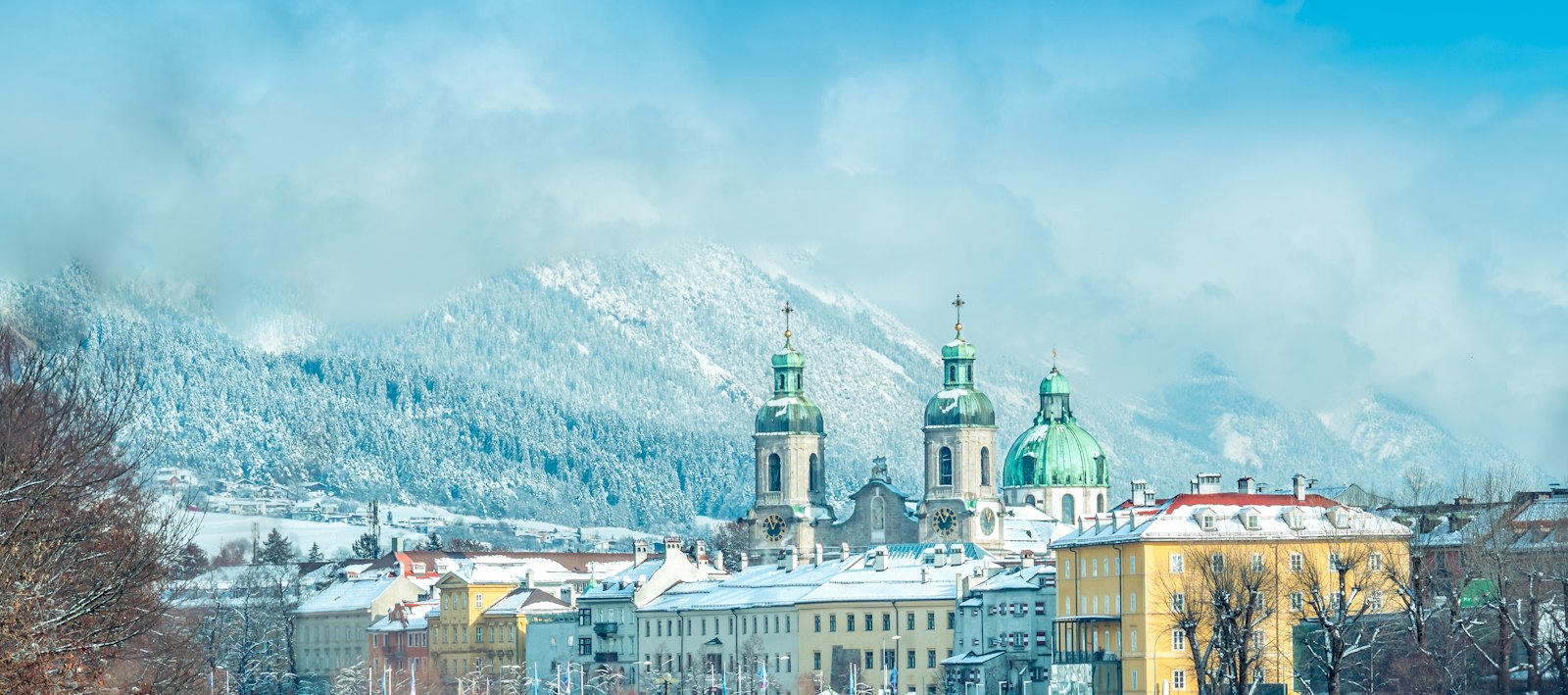
Walk north from the Golden Roof for four minutes and the buildings stop and the Nordkette starts, more or less at the same line. There is no transition, no suburb, no foothill — limestone goes up out of the rooftops like a wall someone built across the top of the town.
The air tells you which day you have got. When the föhn comes over from the south it drops into the Inn valley warming about 1 °C for every hundred metres it falls, and arrives warm, bone-dry and sometimes gusting past 150 km/h. The mountains look close enough to touch and every local blames their headache on it.
The old town is small enough that everything below is within a few hundred metres of everything else, and you will walk all of it.
Tourist trapsThe €56 view, and the crystals that are in another town
A return up the Nordkette to Hafelekar is €56.00 per adult. It is a magnificent ride — three linked lifts from a street in the old town to 2,256 m in about half an hour — and most people pay it without asking two questions. With a Welcome Card and two nights, you get 20% off. And if cloud is sitting on the Seegrube, Hungerburg alone is €14.00 return, still above the city, still a Zaha Hadid station, still a view.
The second is sold hard in every hotel lobby: Swarovski Kristallwelten, €25 online, €27 at the door. It is not in Innsbruck. It is in Wattens, a separate town, and it eats half a day on a trip where Schloss Ambras and the ski jump are closer. I would skip it.
Local pickThe farmers' market inside the Markthalle, before noon
The Markthalle on the river is a working food hall, not a visitor attraction, and the part worth your morning is the Bauernmarkt inside it: Monday to Saturday, 07:00 to 12:00, and no later. Go for Speck, Graukäse and mountain cheese, which travel home better than anything in a souvenir shop. Friday and Saturday there is a farmers' breakfast from 08:00. Sunday the whole building is shut.
Survival rulePark it once, and get the Welcome Card before you do anything else
Ask for the Welcome Card at check-in, before you unpack. It costs nothing, partner accommodation hands it over automatically, and it makes every regional bus, city tram and regional train free for your whole stay — ski buses included. After that, moving the car is a pure loss: you are paying to give up a free seat.
01 · ParkingBlue zone, green zone, and the date the rules tighten
Two systems, and confusing them is expensive. Blue Kurzparkzonen are capped at 90 or 180 minutes and no amount of money extends that. Green Parkstraßen cost the same but have no time limit and cap at €9.00 a calendar day. If you need the car parked all day, you need a green one.
The tariff is €1.10 per started half hour. Until 1 November 2026 the 90-minute zones charge Monday to Friday 09:00–21:00 and Saturday 09:00–13:00. From 2 November 2026 both zone types charge Monday to Friday 08:00–21:00 and Saturday 08:00–18:00. Sundays stay free in the blue zones — but the green streets at Ambras, the Alpenzoo, the Hungerburg and Kranebitten go to daily charging, Sundays included.
The machines take coins and give no change — the city says so itself. My advice is to install Easypark, Park and More or PRESTO-PARKING at the motorway services, because only 32 machines in the centre gain card payment in autumn 2026 and the rest never will.
Check garage heights before the barrier, not at it: Congress Garage is 1.90 m and Zentrum Garage is 2.00 m, which rules out most cars carrying a ski box. The Altstadtgarage is nearest the old town at €19.00 per 24 h.
Car parks worth knowing
| Car park | Price | EV |
|---|---|---|
| InnenSTADT GarageKaiserjägerstraße 1 · 591 spaces, open 0–24, height 2.10 m | €18.00 per 24 h, night €7.00 (19:30–07:00) — **but €4.00 for the whole day 08:00–18:00 if you validate at the Nordkettenbahnen Altstadt ticket desk** | ✓ |
| AltstadtgarageInnrain 4 · the closest to the Goldenes Dachl, 198 spaces, 0–24, height 2.10 m | €3.40 the first hour, then €1.70 per half hour · €19.00 per 24 h | — |
| Congress GarageRennweg 3 · under the Congress, beside the Hofburg and the Nordkette valley station. **Height 1.90 m — the tightest in the centre** | €1.50 per half hour · €18.00 per 24 h · night €7.00 (19:30–07:00) | — |
| MarkthallengarageHerzog-Siegmund-Ufer 5 · by the market hall on the river. **Not 24 h: 05:00–22:00.** Height 2.10 m, no charging points | €3.40 the first hour, then €1.70 per half hour · €22.00 per 24 h · night rate €1.40 per half hour, max €9.00 | — |
| Garage P1Bruneckerstraße 1 · beside the Hauptbahnhof, 184 spaces, 0–24, height 2.10 m | €1.50 per additional half hour · €20.00 per 24 h | ✓ |
| Garage P3Südbahnstraße 1 · also by the station. **Twelve charging points, run by IKB — the best EV provision in the city** | €1.80 per started half hour · €25.00 per 24 h | ✓ |
| Zentrum GarageInnrain 25 · small and central, 72 spaces. **Height 2.00 m — a roof box or ski box will not clear it** | €3.40 the first hour, then €1.70 per half hour · €25.00 per 24 h · charging €0.49/kWh | ✓ |
| Alpenzoo surface zone (the cheap one)Weiherburggasse, across the Inn and uphill · an open city zone, paid at a Parkscheinautomat | **€0.20 per started half hour for the first four hours**, then €1.00 — four hours for €1.60 against €8.80 in a short-stay zone | — |
02 · TowedNobody will tell you where it went
Only the police or the city's mobile enforcement group can order a tow. The bill is published in full and it is steep: €357.60 for the removal, plus €21.60 storage until midnight the following day — €379.20 if you collect it the same day.
What is not published is where the car actually is. Innsbruck gives no pound address, no opening hours and no telephone number, which I have not seen anywhere else in Austria. The city's own instruction is the whole of it: go to the nearest police station and ask. Take the registration document and a card that works abroad.
If your car has disappeared
- Who took it
- Only the police or the city's Mobile Überwachungsgruppe can order a tow under § 89a StVO. The city runs the fee schedule but publishes neither a pound address nor a telephone number.
- Phone
- Austrian police, 133 — the city's own instruction is to ask at the nearest police station: 133
112, the European emergency number, if 133 gets you nowhere from a foreign mobile: 112 - Collect it at
- Not published. Stadt Innsbruck gives no address for the Verwahrungsplatz and no opening hours, which is unusual and worth knowing before you start walking. Its published instruction is: if you think you have been towed, go to the nearest police station and ask.
- Hours
- Not published.
- What it costs
- €357.60 for the tow itself (a car; €321.60 for a motorcycle), plus storage: €21.60 until midnight on the first following day, then €10.80 a day from day 2 to day 7, and €5.40 a day from day 8. Collected the same day, a car costs €379.20.
- Bring
- Not published. The city says only that the towing costs are paid on collection, so assume the registration document, your licence and a card you can actually use.
03 · EVCheap electricity, awkward access
The public network is IKB's, at €0.39/kWh AC and €0.54/kWh DC — good prices. The problem is starting a charge: IKB documents exactly two methods, its RFID card and scanning the socket into the IKB app, and publishes nothing about pay-as-you-go or roaming.
The way round it is the garages. InnenSTADT Garage and Zentrum Garage sell charging at €0.49/kWh billed through the barrier, no account needed, and Garage P3 has twelve points. Up the valley, the Stubai glacier car park has ten posts at €0.38/kWh started by QR code, and parking there is free.
Where to charge
- Garage P3 — Südbahnstraße 1, by the Hauptbahnhof. Twelve points, operated by IKB — the biggest cluster in the city and the easiest to find a free one at
- InnenSTADT Garage — Kaiserjägerstraße 1. Six points, 11 kW AC, €0.49/kWh — billed by the garage, so no IKB account needed
- Zentrum Garage — Innrain 25. Two points, 11 kW AC, €0.49/kWh. Watch the 2.00 m entrance
- Garage P1 — Bruneckerstraße 1. Two points, price shown on the machine
- Stubai glacier valley station (on the way to the snow) — Mutterberg 2, Neustift im Stubaital, about 45 km from the city. Ten points for up to twenty cars at €0.38/kWh, started by QR code with no app — and the car park itself is free
04 · Free spotsThe €21 ticket that moves five people
P+R Olympiaworld and P+R Hafen charge a flat €21.00 a day, and the ticket doubles as an IVB ticket for one to five people across the core zone, 06:00 to 24:00. Against €18–25 for a central garage that carries nobody anywhere, it is the best value in the city.
Second best is a trick from the cable car company: park in the InnenSTADT Garage, have the ticket validated at the Altstadt ticket desk, and the day 08:00–18:00 costs €4.00 instead of €18.00.
Third, the city's fee ordinance gives the surface zone by the Alpenzoo its own rate: €0.20 per half hour for the first four hours. An afternoon for €1.60.
Free kerbside parking starts outside the managed area. No official source publishes walking times, and three more districts become paid zones in November 2026, so last winter's spot may not be one now.
Free or nearly-free spots
P+R Olympiaworld and P+R Hafen — €21 for the car and five people
A flat €21.00 a day, and the ticket doubles as an IVB ticket on every line in the Innsbruck core zone for one to five people, 06:00–24:00. The Sightseer line S is the only exclusion. Against €18–25 for a central garage that moves nobody, this is the one genuinely good deal in Innsbruck parking. P+R Olympiaworld is the one most visitors want.
The €4 garage day, if you are going up the Nordkette
The cable car operator's own arrangement: park in the InnenSTADT Garage and get the ticket validated at the Altstadt-Station ticket desk, and the whole day 08:00–18:00 costs €4.00 instead of €18.00. You have to buy a cable car ticket, so it is not free parking — but it is the cheapest central all-day rate in the city by a wide margin.
The Alpenzoo zone: four hours for €1.60
The city's own fee ordinance sets a separate rate for the surface zone up on Weiherburggasse, across the Inn: €0.20 per started half hour for the first four hours. That is €1.60 for an afternoon against €8.80 in a short-stay zone. It is uphill and a walk from the old town, and from 2 November 2026 it is charged on Sundays too.
Free street parking exists — outside the managed area, and it is shrinking
Everything inside the managed area is either a blue short-stay zone or a green paid parking street. Free kerbside parking starts beyond it, in the outer districts. Be honest with yourself about the walk: the city publishes no distances, and on 2 November 2026 Kranebitten, Arzl and Olympisches Dorf all become paid green zones, so last winter's free spot may not be one this winter.
Bergisel: fifteen minutes free, and closed on Tuesdays in winter
The Bergisel car park is barrier-free and reads your plate on the way in; the first fifteen minutes are free and you pay at a touchscreen or through the Easypark app. The car tariff is not published. Worth knowing before you drive up: from November to May the site is closed on Tuesdays, last entry 16:30.
Hotels with free parking
- Boutiquehotel Weisses Rössl — Kiebachgasse 8, in the old town Map. Its own site does not advertise guest parking, and the street is in the pedestrianised core — treat it as a garage-and-walk, not a drive-up
- Hotels at the Hauptbahnhof — Around Südtiroler Platz Map. Garages P1 and P3 are right there at €20–25 per 24 h. I could not verify free parking at any specific station hotel, so do not assume it — ask before you book
⚠ The small print on 'free' parking
- The A12 is 100 km/h, not 130. About 90 km of the Inntal motorway between the German border and Zirl, plus 12 km of the A13 between Innsbruck and Schönberg, carry a permanent year-round IG-L air-quality limit of 100. It is enforced by six fixed front-radar units as well as mobile police radar. If you are driving in from Munich, this is your whole approach.
- The parking rules change on 2 November 2026. Until then, 90-minute zones charge Monday to Friday 09:00–21:00 and Saturday 09:00–13:00. From that date both zone types charge Monday to Friday 08:00–21:00 and Saturday 08:00–18:00 — an hour earlier every morning and five extra hours on Saturday. The hourly tariff does not change.
- The ticket machines take coins and give no change. The city says so on its own English page. Thirty-two machines in the centre are being upgraded to card payment in autumn 2026; the rest are not. Sort out a parking app on the motorway services, not at the meter with a handful of euros.
- Blue zone and green zone are not the same thing. Blue Kurzparkzonen are time-limited to 90 or 180 minutes and you cannot buy your way past that. Green Parkstraßen cost the same €1.10 per half hour but have no time limit and cap at €9.00 a calendar day. If you need to leave the car all day, you need a green one.
- Check the height before you book a garage. Congress Garage is 1.90 m and Zentrum Garage 2.00 m. With a roof box or a ski box on the car — which is most of the winter traffic — both are out, and so is the barrier before you have anywhere to reverse to.
- Austria wants 4 mm of tread, not 1.6 mm. From 1 November to 15 April the winter equipment rule applies whenever there is snow, slush or ice on the road, and winter tyres must carry M+S or the snowflake and have at least 4 mm. The fine is €35, rising to as much as €5,000 if you endanger someone.
- There is no low-emission zone and no windscreen sticker. Austria has no Umweltplakette for cars and Innsbruck has no emissions-based access restriction. You need the motorway vignette and nothing else. The signs you will see about sectoral and night driving bans apply to lorries over 7.5 t, not to you.